South Korea’s Mega AI-Semiconductor Push Sends Shockwaves Through Global Storage Markets
Keywords: South Korea, semiconductor investment, AI infrastructure, DRAM, HBM, memory chips, storage stocks, A-shares, SK hynix, Samsung Electronics, ChangXin Technology, GigaFactory, AI data centers
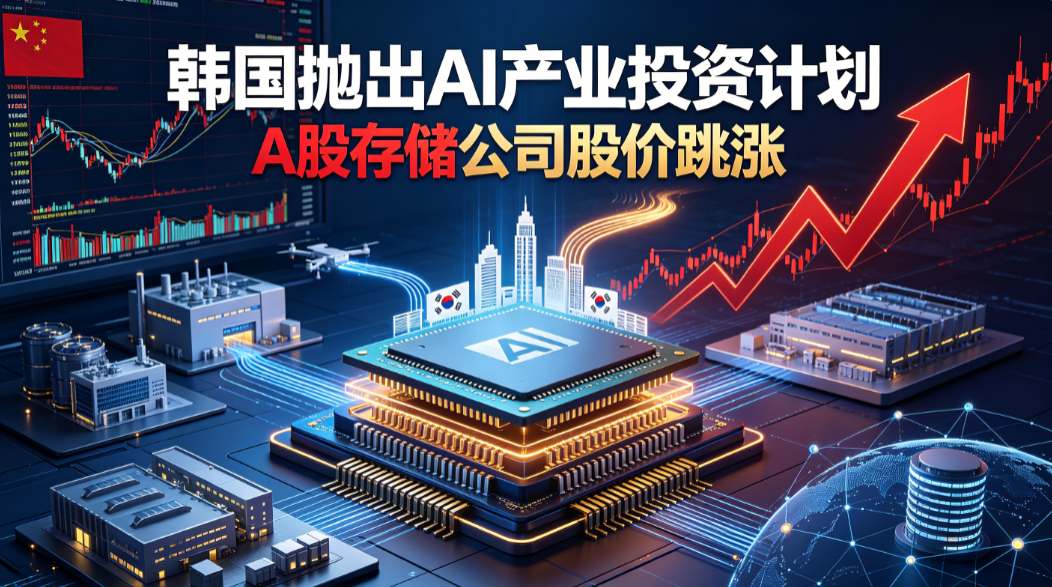
On June 29, the South Korean government unveiled its largest-ever industrial investment package centered on semiconductors and artificial intelligence, formally positioning semiconductors, physical AI, and AI data centers as the “three pillars” of national industrial upgrading. The move is widely seen as a strategic bid to place South Korea among the world’s leading “AI revolution” countries. The announcement quickly reverberated across financial markets: SK hynix briefly rose after the news but closed down 1.68%, while Samsung Electronics fell 4.76%. In contrast, related Chinese A-share companies surged, with Skywell Technology hitting the daily limit up and GigaDevice rising nearly 9%.

A Record Investment Plan Anchored by Memory Chips
At the core of the Korean policy package is a massive expansion of memory-chip capacity. According to the government, Samsung and SK hynix will invest approximately 800 trillion won in four chip plants in the southwest region of the country, with the goal of doubling DRAM production capacity within five years. Officials also projected that the global memory market could grow fourfold in the coming years.
Beyond manufacturing, South Korea plans to invest more than 1,000 trillion won in AI data centers by 2035 and allocate another 81 trillion won for chip packaging facilities in the Chungcheong region. The scope of this plan shows that the government is no longer treating semiconductors as a single industrial sector, but as the foundation of a broader AI infrastructure ecosystem.
At the investment announcement, Samsung Chairman Lee Jae-yong revealed that the group’s domestic total investment will reach 2,655 trillion won. More than 2,000 trillion won will be directed to the semiconductor cluster in Pyeongtaek and Yongin, with construction of the Yongin campus being accelerated. SK Group Chairman Chey Tae-won also announced combined investment of 2,100 trillion won in AI and semiconductors, including 1,100 trillion won from SK hynix to expand chip production and ease the AI memory shortage.
Capacity Expansion Becomes a Strategic Necessity
SK hynix said its investment strategy was formulated after fully considering government policy, the broader business environment, and future market demand. The company emphasized that it will work closely with the government to develop specific infrastructure plans and approval procedures. However, because large fabs require reliable electricity and water supplies, future investment decisions will still be made from a commercial perspective and aligned with the government’s readiness to provide essential infrastructure. At present, there is no confirmed announcement regarding new sites.
The logic behind this investment wave is straightforward: advanced memory is becoming both more valuable and harder to make. As semiconductor process technology advances, producing the same storage capacity requires more manufacturing space and more sophisticated equipment. Compared with conventional DRAM, HBM requires significantly more wafers to deliver equivalent capacity. Since a new fab takes years to complete, securing capacity early has become a crucial competitive advantage.
SK hynix also noted that capital expenditures will not be deployed all at once. Instead, investment will be phased based on demand visibility. The company said it will continue working closely with customers to validate medium- and long-term demand and invest in sequence according to capital discipline. This reflects a broader industry shift: even in a cyclical market, leading manufacturers are increasingly planning around structural AI demand rather than short-term memory pricing alone.
A-Shares React: Storage Stocks Enter a New Narrative
While the Korean market digested the state-backed expansion plan, A-share storage-related companies saw strong gains. On June 29, the domestic memory sector posted modest overall growth, but stocks linked to ChangXin Technology stood out sharply. GigaDevice surged about 9% to a record high, with turnover reaching 43.15 billion yuan, while Skywell Technology hit the daily limit up.
The catalyst was not only external policy news but also expectations that the storage industry is moving from a traditional cyclical story to an AI infrastructure story. This change in narrative is significant. In the past, memory stocks were viewed mainly through the lens of commodity-style booms and busts. Today, with AI servers driving explosive demand for high-bandwidth and high-capacity storage, investors are increasingly willing to pay for visibility, scale, and long-term supply agreements.
Industry developments abroad reinforce this shift. Micron Technology recently announced 16 long-term supply agreements, many of them five-year take-or-pay contracts. The guaranteed revenue associated with these agreements reportedly exceeds $100 billion, along with $22 billion in cash deposits and related commitment support. These contracts cover 20% of Micron’s DRAM sales and one-third of its NAND sales, illustrating how memory suppliers are trying to stabilize earnings through deeper customer lock-in.
ChangXin Technology and the Market’s Long-Term Expectations
In China, speculation around ChangXin Technology continues to fuel optimism across the storage chain. Market rumors suggested Apple may seek approval to procure ChangXin memory chips to offset rising memory costs, and that ChangXin may have signed a long-term supply agreement worth more than 20 billion yuan. Although neither claim has been officially confirmed, the mere possibility underscores the strategic value of domestic memory supply in a tight global market.
Policy momentum has also strengthened. On June 12, China’s securities regulator approved ChangXin Technology’s IPO registration application. Supported by booming AI server demand, global DRAM prices have remained elevated, and ChangXin’s operating performance has reportedly entered a period of explosive growth. According to disclosed projections, the company is expected to post revenue of 110–120 billion yuan in the first half of this year, up 612.53% to 677.31% year on year, with net profit projected at 50–57 billion yuan.
Such numbers help explain why the market is willing to re-rate storage assets. Once seen as highly cyclical manufacturing businesses, leading memory companies are now being valued as strategic infrastructure providers in the AI era.
GigaDevice Hits New Highs as ETF Flows Add Momentum
GigaDevice’s performance further highlights how capital markets are chasing the new memory thesis. The company was recently added to Roundhill Memory ETF (DRAM), the world’s first actively managed ETF focused on the memory sector, becoming its eighth-largest holding. This inclusion has reinforced global investor attention on Chinese storage assets.
Still, the company has repeatedly warned investors about the industry’s historical cyclicality. In its trading risk alerts, GigaDevice noted that memory prices can eventually normalize toward more sustainable levels, which would affect product pricing, gross margins, and overall profitability. The company also disclosed that its stake in ChangXin Technology is only 1.8% of total equity and gives it no meaningful control over operational decisions.
Similarly, Skywell Technology issued an abnormal trading announcement stating that its indirect investment in ChangXin is small, its ownership share is extremely low, and it does not have control or material influence over decision-making. It also cautioned that fund exits and investment returns remain uncertain in both timing and size, and therefore will not have a major impact on company earnings.
Conclusion: AI Infrastructure Is Rewriting the Memory Cycle
The latest wave of announcements from South Korea shows that governments and leading chipmakers are now treating memory as a strategic pillar of the AI economy. Massive investments in fabs, packaging, and data centers signal that supply-side expansion is being accelerated to match structural demand from AI applications.
For investors, the implication is clear: the storage industry is no longer being priced solely as a cyclical component market. It is increasingly viewed as a core layer of AI infrastructure, with long-term contracts, capacity security, and supply-chain resilience becoming the new competitive metrics. That said, the sector remains exposed to execution risk, infrastructure constraints, and eventual pricing normalization. In other words, the long-term opportunity is substantial, but so is the need for disciplined capital allocation and realistic demand forecasting.
As South Korea, China, and global memory leaders reposition themselves for the AI era, the semiconductor industry is entering a new phase—one in which industrial policy, infrastructure readiness, and market structure are becoming just as important as technology leadership itself.