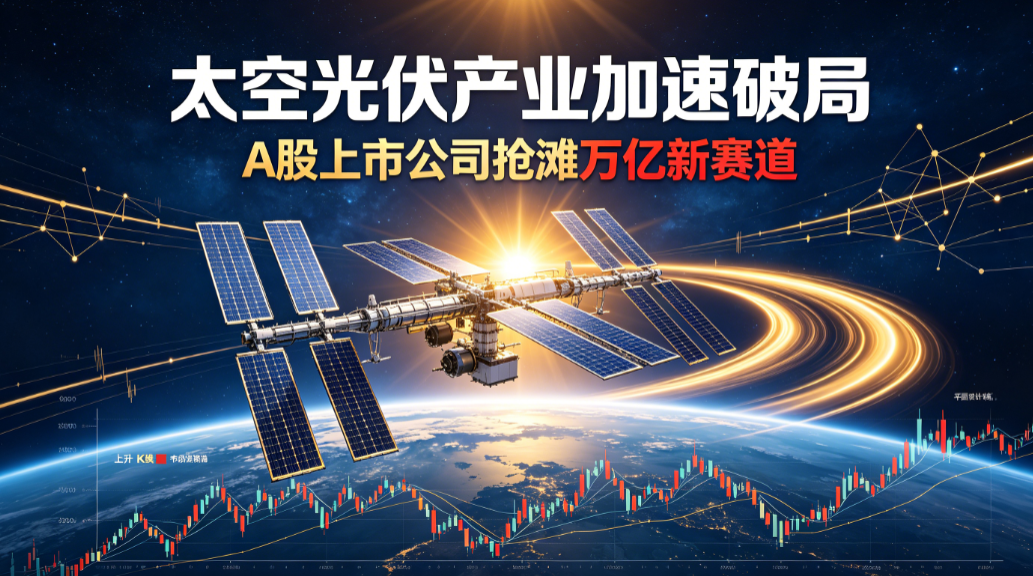
Space Photovoltaics: The Next Growth Curve for the Solar Industry
Keywords: Space Photovoltaics, Low-Earth Orbit, Perovskite Tandem Cells, Satellite Power Systems, In-Orbit Validation, Aerospace Materials, Industrial Alliances, New Energy Transition
The rapid expansion of low-Earth-orbit satellite constellations is creating a new wave of demand for satellite power systems. Against this backdrop, a growing number of A-share listed solar companies have recently announced investments, strategic partnerships, joint laboratories, and other collaborations related to space photovoltaics. From silicon wafers and encapsulation materials to perovskite cells, companies are extending their capabilities across the full industrial chain in an effort to capture the emerging space-energy market.
Industry observers believe the sector is entering a period of accelerated integration. Multiple technology paths are being tested in orbit at the same time, while cross-industry alliances are being established to coordinate R&D and verification. Several institutions now estimate that the long-term market size of space photovoltaics could reach the trillion-yuan level. In an industry still facing overcapacity and intense competition on Earth, space photovoltaics is increasingly seen as a new growth curve that may help the solar sector move beyond its current cycle.
A New Battlefront for Listed Solar Companies
The latest wave of corporate announcements shows that Chinese photovoltaic companies are not merely observing the space market—they are moving in with clearly differentiated strategies.
On the cell side, Tongwei has entered into strategic cooperation with Yanhuo Technology, a company focused on aerospace perovskite technologies. Their collaboration targets tandem cells and flexible solar wings designed for the harsh conditions of space, while also advancing aerospace-grade qualification certification. Meanwhile, Junda Shares has entered the space photovoltaics field through investment in an aerospace optics company, focusing on flexible perovskite tandem cells for satellites. These products are now under laboratory verification, with commercial use depending on successful in-orbit testing.
On the materials side, Foster, one of the leading suppliers of photovoltaic encapsulation films, has also partnered with Yanhuo Technology. The two sides are developing aerospace-grade modified encapsulation materials tailored to vacuum, strong ultraviolet radiation, and other severe space conditions. Their plan is to conduct multiple rounds of in-orbit testing using satellite payloads, continuously improving formulations based on real-world data.
Another notable example is Huamin Shares, which has joined forces with Kongtian Dongneng to build a joint laboratory for flexible crystalline-silicon space photovoltaics as well as a pilot platform for space-based silicon cell manufacturing. According to the company’s investor relations disclosures, Huamin has already supplied space-photovoltaic-specific silicon wafers to several leading domestic photovoltaic companies, including Maiwei, East Hope, Tongwei Solar, and Trina Solar, as well as to some overseas customers.
This reflects an important shift in the industry: competition is no longer limited to conventional ground-based module manufacturing. Instead, it is evolving into a race to define the next generation of aerospace power supply technologies. As Huamin’s chairman Ouyang Shaohong noted, space photovoltaics and terrestrial photovoltaics differ fundamentally. Satellite operation in orbit involves extreme temperature swings, intense radiation, vacuum conditions, and microgravity, all of which place much higher demands on wafer purity, stability, and radiation resistance.
Perovskite Tandem Cells Are Emerging as the Preferred Path
Within the industry, 2026 is increasingly being regarded as the commercial launch point for space photovoltaics. However, commercialization is not simply a matter of installing existing solar products on satellites. Aerospace R&D is capital-intensive, certification procedures are lengthy, and the cross-industry barriers between photovoltaics and aerospace are high. Under these conditions, a single company is unlikely to complete the full chain of technological breakthroughs alone.
As a result, alliance-based collaboration has become the mainstream model. In early June, two major alliances were unveiled almost simultaneously. Huaneng Group and Trina Solar launched the Space Energy Development Alliance, while JinkoSolar took the lead in forming the Space Energy Technology Ecosystem Alliance together with companies such as Seve and Jiejia Weichuang. These alliances bring together resources from the solar, materials, equipment, and aerospace sectors, aiming to break down barriers and coordinate technology development, environmental simulation, and in-orbit testing.
Why is the industry placing such high hopes on perovskite tandem cells? The answer lies in the unique operating environment of space. Solar cells used in orbit must withstand strong radiation, extreme thermal cycling, vacuum conditions, and atomic oxygen erosion. These factors can quickly degrade output efficiency and shorten service life.
Compared with traditional space-grade cells, perovskite thin films offer several compelling advantages: they are lightweight, more tolerant of radiation in certain configurations, and potentially lower-cost in terms of raw materials and manufacturing. These features align well with the requirements of satellite weight reduction and launch-cost optimization. For this reason, perovskite tandem cells are increasingly viewed as one of the most promising technical routes for space applications.
According to industry leaders, falling launch costs are also strengthening the business case. Reusable rockets are helping to reduce the cost of putting payloads into orbit, while low-Earth-orbit mega-constellations are generating scale-driven, recurring demand. Under such conditions, space photovoltaics is gradually moving from conceptual exploration toward engineering implementation. Chairman Zhu Gongshan of GCL Group has argued that once radiation-resistant encapsulation technology achieves a breakthrough, perovskite products could enter batch use across a wide range of spacecraft within five to ten years. Trina Solar Chairman Gao Jifan has also stated that laboratory efficiency for perovskite tandem cells has already surpassed 35%, making them a core future power solution for spacecraft.
Multiple Technology Routes Are Advancing in Parallel
Although perovskite tandem cells are attracting the most attention, the industry is not betting on a single route. Instead, it is pursuing parallel validation across several mature technologies, each suited to different application scenarios.
At present, three main technology paths are being tested in orbit: flexible HJT, perovskite tandem, and gallium arsenide cells. Gallium arsenide is a mature and stable technology, widely used in high-end deep-space exploration missions. Flexible HJT cells are lightweight and bendable, making them suitable for small and medium-sized commercial satellites. Perovskite tandem cells combine high efficiency with lower cost, positioning them for low-Earth-orbit mega-constellations and, in the long run, for space solar power stations and energy supply systems on lunar or other extraterrestrial bases.
This multi-route approach is not only technologically prudent but also commercially rational. Different mission profiles have different reliability requirements, budget constraints, and payload considerations. By developing a diversified technology portfolio, the industry can reduce single-route risk and create clearer pathways from laboratory R&D to real deployment.
From a broader perspective, space photovoltaics is not a separate industry detached from terrestrial solar. Rather, it is a high-value extension of mature photovoltaic technology into a new application environment. That distinction matters. On Earth, the solar sector often competes on cost, scale, and efficiency alone. In space, however, the value of reliability, durability, and mass reduction rises sharply. This changes the pricing logic and may ultimately create higher margins than conventional ground-based solar products.
Market Potential Could Reach the Trillion-Yuan Scale
Although the sector is still in a research-intensive stage, the long-term market outlook is drawing increasing attention from institutions.
According to research from China Galaxy Securities, the global space photovoltaics market is expected to reach about RMB 56.9 billion in 2026. As low-Earth-orbit satellite constellations continue to expand, the market could grow to RMB 1.0998 trillion by 2035—nearly 20 times higher than the 2026 level. CITIC Securities is even more optimistic, estimating that global demand for space photovoltaics could reach 70 GW by 2030, corresponding to a market size approaching RMB 3 trillion.
These forecasts are rooted in a structural shift. In the past, space power systems were mainly tied to a small number of national space missions. Going forward, however, commercial satellites, broadband constellations, lunar exploration bases, and potentially large-scale space solar stations could all become demand drivers. In other words, the market is no longer dependent solely on one-off missions; it may gradually evolve into a continuous industrial market.
That said, the sector has not yet developed a standardized or sustainable commercial model. Most listed companies’ related businesses remain in the R&D and validation stage and have not yet contributed meaningful recurring revenue. Certification cycles are long, and long-term reliability under extreme conditions remains unproven. These are the key bottlenecks restricting near-term volume growth.
Nevertheless, the strategic significance is clear. If the industry can solve the core technical challenges around encapsulation, radiation resistance, thermal stability, and in-orbit durability, it could unlock a market far larger than today’s terrestrial photovoltaic segment. In that sense, space photovoltaics is not merely a niche extension; it could become a new frontier for the entire solar industry.
Conclusion: From Ground-Based Competition to Space-Based Expansion
The surge in space photovoltaics is more than a short-term investment trend. It reflects a deeper transformation in the photovoltaic sector: from homogeneous competition on the ground to differentiated innovation in space. As low-Earth-orbit satellite constellations scale up and aerospace demand becomes more commercialized, solar companies are seeking new ways to convert technological capability into long-cycle value.
The current phase is still characterized by heavy R&D spending, multi-path validation, and uncertain commercialization timelines. Yet the direction is unmistakable. Companies are forming alliances, building laboratories, upgrading materials, and pursuing in-orbit verification in parallel. This suggests that the industry is no longer asking whether space photovoltaics is possible, but how quickly it can be engineered into a reliable, scalable supply chain.
In the long run, space photovoltaics may do more than create a new market. It may redefine the competitive logic of the solar industry itself, opening up a new growth curve that can help the sector move beyond cyclical pressures and toward a broader horizon of value creation.