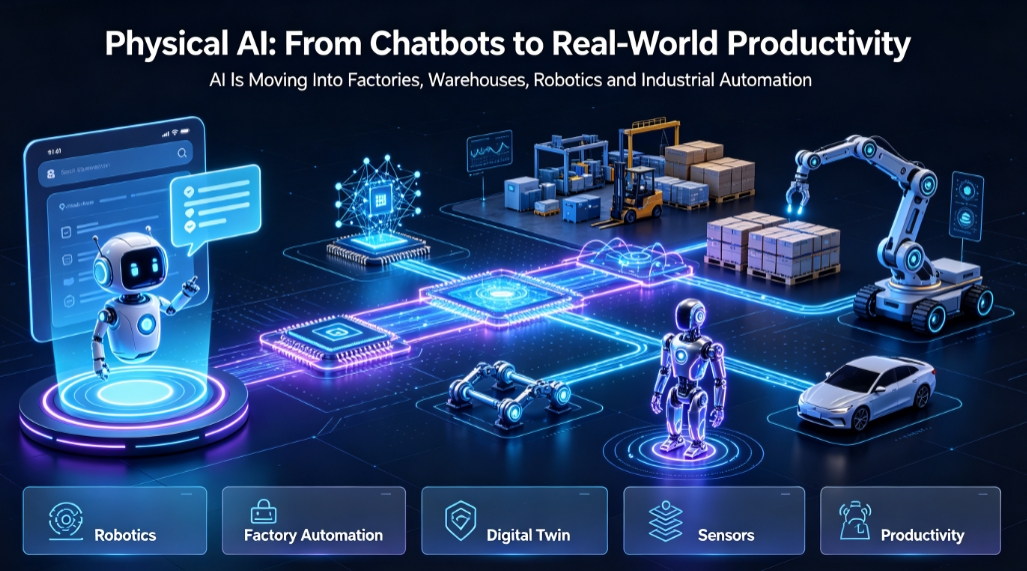
The next major AI trend will no longer center on which chatbot writes better copy, but who can bring AI into the physical world. The real value of Physical AI lies in equipping AI with a tangible body to cut costs, boost efficiency and lift productivity across real-world operations.
Two recent robotics industry headlines perfectly illustrate this point. On one hand, China’s UBTech launched AI companion humanoid robots with hyper-realistic appearances. Its top-tier model costs nearly one million RMB, and UBTech states the U1 series has secured 13,361 pre-orders with deliveries scheduled before year-end.
On the other hand, Swedish bearing giant SKF formed a joint venture with China’s GreenHarmonic to exclusively manufacture high-precision transmission components for robot joints. One side creates futuristic product visions, while the other underpins the entire industrial supply chain. The more sci-fi the front-end robots look, the more grounded the back-end manufacturing cost sheets are — and the core investment value of Physical AI sits precisely between these two layers.
When most people see humanoid robots, they picture robotic housekeepers or nannies. But capital markets care far less about whether robots can hold casual conversations and far more about whether they can take over factory labor, slash warehouse operating expenses, and raise efficiency in hospitals and energy infrastructure. Chat-based AI solves the “talking problem”; Physical AI solves the “doing problem.” The former enables AI to generate language, while the latter deploys AI onto actual production floors.
Hello everyone, this is LI Finance. Today we break down a new investment theme moving out of labs and into capital markets: Physical AI, also known as embodied intelligence. It is not merely wrapping a large language model inside a robot shell; instead, it endows AI with perception, reasoning, motor control and real-time feedback capabilities. Starting from the latest industry news, this analysis explains why Jensen Huang and Elon Musk are betting big on this track, why China’s supply chain is racing to catch up, and finally shifts to investment analysis to identify segments most likely to turn conceptual visions into tangible orders.
If you want to keep track of which new technologies Wall Street is repricing, hit the like button and subscribe. This video is not just a showcase of cool robots; we dissect the Physical AI industrial chain to reveal where genuine profits will emerge and which trends are only short-lived hype.
Previously, AI existed almost entirely behind screens. You ask it questions, it responds; you request copywriting, it delivers drafts. Intelligent as it is, it lacks a physical form. Physical AI aims to give this intelligent brain eyes, arms, wheels, and the ability to judge real-world environments.
This task is vastly more complex than conventional screen-based AI, because the physical world is not a clean digital input box. Dragging files on a computer will not cause them to slip; when a robot grabs a cup, the cup may shatter, its arm may misalign, and a human might suddenly reach across its workspace. Autonomous vehicles travel alongside not just speed limit signs and traffic lights, but stray animals, delivery riders, construction cones, and countless unpredictable human behaviors. When a factory robotic arm picks up components, what looks like a simple grabbing motion relies on simultaneous operation of visual recognition, force feedback, path planning and safety control systems. The core of Physical AI is not human-like appearance, but consistent task execution amid chaotic real-world environments.
This is why Jensen Huang continuously emphasizes Physical AI. NVIDIA’s ambitions extend beyond selling GPUs; the company aims to become the core computing platform, virtual training ground and system hub for the Physical AI era. Huang once stated, “Physical AI has arrived, every industrial company will become a robotics company.”
Though this statement sounds ambitious, NVIDIA’s strategy is concrete. For NVIDIA, Physical AI does not represent an abrupt business pivot — it extends its existing strengths in large model training, world model generation, industrial simulation and edge inference into physical scenarios. It supplies training computing power via GPUs, builds virtual training environments for robots through Omniverse, Isaac Sim and Cosmos, deploys inference capabilities to robot edge devices with Jetson Thor, and advances universal robotic motor skills via foundation robot models such as GR00T.
That said, it is critical to clarify that Physical AI functions primarily as NVIDIA’s next growth narrative, not its main revenue driver today. Data center AI computing still underpins its stock price in the short term, fueled by sustained GPU demand from cloud vendors, enterprises and diverse AI applications. Physical AI merely expands this ecosystem into factories, logistics, autonomous driving and robotics. Put simply, NVIDIA is not abandoning chip manufacturing to build robots; it wants every robot to rely on its ecosystem during training, simulation and real-time operation.
This brings us to the most vital investment logic for Physical AI: the most certain short-term opportunities likely lie not with humanoid robot OEMs, but with “pick-and-shovel” component suppliers. Mass-producing robots requires chips, simulation software, sensors, actuators, joints, vision systems and edge computing hardware. Robot OEMs easily grab public attention yet burn through massive capital. Supply chain firms may lack headline appeal, but they tend to generate revenue faster once order cycles kick in. During gold rushes, not every prospector strikes gold, yet tool sellers almost always get paid upfront.
Elon Musk pursues a distinct path. While Tesla is outwardly an automaker, its core long-term vision centers on real-world physical AI. Robotaxis function as car-shaped robots, and Optimus serves as its humanoid robot; both share the foundational logic of enabling AI to perceive, judge, navigate and complete practical tasks in physical environments.
On July 2, Tesla reported Q2 deliveries of 480,126 vehicles and production of 451,758 units, with delivery figures far exceeding many bearish market forecasts. In past cycles, such results would have lifted its stock price, yet shares faced downward pressure this time around. The market fully acknowledges strong delivery demand, but remains unanswered on when profit margins, Robotaxis, FSD and Optimus will generate meaningful revenue. Wall Street’s evaluation of Tesla has shifted from “can it sell cars?” to “can its AI vision deliver profits?”
This captures Tesla’s current delicate market position: investors do not fully dismiss Musk’s vision, but demand tangible earnings to match his narratives. Tesla’s Q1 shareholder materials disclosed ongoing production line preparation for Optimus. Its first-generation Fremont factory targets an annual output of one million robots, while the second-generation Texas Gigafactory holds a long-term design capacity of ten million units per year. It is crucial to distinguish production design targets and facility planning from actual sold robot volumes. Confusing capacity blueprints with realized profits is one of the most common misconceptions among investors. Buying a gym membership does not guarantee a chiseled physique the next day — it only signals intent to train.
The success of Optimus hinges not on flashy product launches, but on production costs, yield rates, operational stability, maintenance infrastructure and genuine customer orders. Viral videos of robots dancing draw clicks, yet Wall Street ultimately judges their value by consistent factory operation, minimal error rates and cost competitiveness versus human labor. Household deployment proves far more challenging, as cluttered living spaces filled with slippers, pets, delivery packages and charging cables create endless unpredictable variables. By contrast, semi-structured environments including factories, warehouses, logistics hubs, energy inspection sites and medical assistance facilities feature clear task frameworks and controlled surroundings, enabling straightforward ROI calculations.
China’s competitive advantage rests firmly on its robust manufacturing foundation. While China may not lead in every core algorithm, it boasts obvious strengths in hardware supply chains, cost control and mass production efficiency. Automobiles, electronics, lithium batteries, sensors, motors, reducers and industrial robots already form mature domestic manufacturing ecosystems. For AI to move beyond screens into the physical world, commercialization ultimately hinges on hardware, production capacity and pricing — areas where China’s supply chain excels.
New energy vehicles have already demonstrated this development trajectory. Early market discourse focused on brand ideals, smart features and futuristic visions, before competition shifted to battery costs, supply chain efficiency, distribution channels and price wars. The robotics sector will likely follow the same pattern. Early public attention fixates on robot mobility tricks such as running, jumping or carrying coffee mugs; once commercialization begins, markets prioritize joint component costs, motor efficiency, reducer lifespans, sensor precision, total robot pricing and after-sales service networks.
China has not yet achieved dominance in humanoid robots, but it possesses powerful cost-reduction capabilities and abundant manufacturing test scenarios. Clear short-term limitations persist: most humanoid robots remain limited to exhibitions, research labs, education platforms, testing and small-batch pilot deployments. Impressive performance demos do not equal profitable operations, nor does a robot’s ability to carry coffee cups mean it can operate reliably in factories for a full year. In many manufacturing plants, the first profitable automation solutions may not be humanoid robots at all, but cheaper, more stable and durable traditional mechanical arms and automated systems.
This statement lacks sensational appeal yet reflects industry reality. Capital markets favor humanoid robots for their imaginative growth potential, while factory operators prioritize stable equipment that minimizes accidents and maximizes production uptime. The true industrial inflection point arrives not when online video views surge, but when orders, production yields and positive cash flow materialize simultaneously.
If you now understand that Physical AI extends far beyond a simple robotics concept to form a complete industrial chain spanning computing power, robot joints, sensors and factory deployment all the way to capital markets, this video has delivered its core value. Hit like and save this content for future reference; I will continue tracking this track, particularly firms transitioning from conceptual storytelling to securing formal orders.
This is why the SKF and GreenHarmonic joint venture news merits close attention. It lacks the spectacle of robot launch events yet captures the heart of industrial reality. Robot mobility relies entirely on joints; stable joints demand mature high-precision transmission components; mass production of such parts hinges on supply chain and manufacturing prowess. The highest-value industrial segments are rarely the loudest ones — they are the indispensable links every buyer must source once orders roll in.
We now turn to Justin Sun’s relevant moves. Public reports confirm Sun expanded TRON DAO’s AI fund from $100 million to $1 billion, targeting sectors including Physical AI, embodied intelligence, drones, spatial computing and space exploration. This claim requires careful contextualization. Official TRON DAO statements frame the fund’s core focus as AI Agent economic infrastructure, covering digital identity systems, stablecoin payments, RWA tokenization and developer tooling. Claiming the full $1 billion fund is exclusively allocated to humanoid robots oversimplifies its mandate.
A more accurate interpretation: capital markets are collectively repricing forward-looking narratives including AI Agents, blockchain payments, RWA, spatial computing and Physical AI under one investment bucket. This signals Physical AI has evolved from a niche engineering technical term into a mainstream capital market theme. Nevertheless, a critical gap separates market narratives and viable investments: commercial validation. Justin Sun’s talent for capturing market hype and generating media attention is undeniable, yet retail investors should not treat celebrity-endorsed trends as a guarantee that every crypto token, robotics concept stock or shell company will replicate NVIDIA’s success. Market booms inflate countless assets, yet only businesses supported by sustainable cash flow survive once the hype fades.
From an investment perspective, Physical AI represents an extensive industrial chain rather than a single isolated opportunity. However, firms across the chain capture vastly different degrees of direct value. Some build foundational infrastructure with clear exposure, others benefit indirectly, and many merely trade on thematic sentiment. Before investing, investors must evaluate what percentage of a company’s total revenue stems from relevant Physical AI business lines, rather than only its thematic label.
Short-Term High-Certainty Segments: Computing Power & Simulation Platforms
NVIDIA (NVDA) is irreplaceable here, as its competitive edge extends beyond GPUs to an integrated ecosystem of computing power, software, simulation platforms, edge computing and foundation robot models. More complex Physical AI applications drive greater training and inference demand, cementing NVIDIA’s position as core infrastructure. Its stock price already embeds extremely high growth expectations, however, making shares highly sensitive to any slowdown in enterprise AI capital expenditure.
Medium-Term High-Tracking Segments: Industrial Automation, Machine Vision, Sensors & Warehouse Logistics
Industrial automation firms including Rockwell Automation, Honeywell, Emerson and Eaton lack the viral appeal of humanoid robots yet maintain deep factory integration. Deploying Physical AI in industrial settings requires far more than robot hardware; it demands PLCs, sensors, industrial software, power control units, safety systems and edge computing infrastructure. These companies operate behind-the-scenes mission-critical automation infrastructure essential for factory upgrades.
Machine vision and sensors constitute another critical link. Firms such as Cognex deliver deceptively simple yet high-value functionality: enabling machines to interpret the physical world. Robots cannot complete labor tasks without identifying components, defects, obstacles and human workers. Even the most advanced large language models remain useless on the factory floor without real-world environmental awareness. Wider Physical AI adoption amplifies demand for visual inspection systems, 3D perception hardware, force sensors, LiDAR and edge vision chips.
Warehouse logistics stands out as one of Physical AI’s most realistic testbeds. Symbotic merits close monitoring, alongside Amazon (AMZN). While Amazon is not a pure-play Physical AI firm, its warehouse robotics, logistics networks and automated operations serve as real-world case studies for scalable Physical AI deployment. The first large-scale profitable robotics deployments will likely occur in warehouses rather than residential homes, as logistics facilities prioritize stability, accuracy and low costs over emotional companion functionality.
Long-Term High-Upside Segments: Real-World AI Platform OEMs
Firms such as Tesla (TSLA), which aims to build Robotaxi and Optimus into full-stack real-world AI platforms, carry the greatest long-term growth potential. Successful mass deployment of Robotaxis and Optimus would redefine Tesla’s valuation narrative from an automaker to a comprehensive physical AI platform provider. Delayed commercialization, by contrast, will force the market to reassess whether Tesla functions primarily as a car manufacturer, an AI enterprise, or a high-valuation conglomerate loaded with unproven long-term visions. Tesla suits long-term observation rather than impulsive investment based solely on Musk’s public remarks.
Medical and specialty scenario robotics follow slower commercialization timelines yet hold formidable competitive moats. Intuitive Surgical leads surgical robotics, while Medtronic maintains broad exposure to medical devices and operating robots. Strict regulatory oversight, lengthy clinical validation cycles and ultra-low error tolerance delay mass profitability for medical robotics. However, once clinical trust and systemic barriers are established, these businesses retain enduring long-term value.
Autonomous driving, drones and defense robotics also fall under the broader Physical AI industrial chain. AeroVironment specializes in unmanned systems and military drones, while Mobileye focuses on ADAS and autonomous driving vision solutions. These asset classes exhibit drastically different sensitivity to Physical AI growth, so they serve purely as watchlist candidates rather than direct buy recommendations. All investment decisions must root in financial statements, order volumes, gross margins, cash flow, valuation metrics and competitive landscape analysis.
When evaluating Physical AI companies going forward, investors should prioritize three factors: viable real-world deployment scenarios, sustainable cost reduction trajectories, and critical positioning within the supply chain. Robot OEMs offer high upside alongside extreme operational risks; core component suppliers deliver more stable returns; computing, software, simulation and platform providers operate classic pick-and-shovel businesses for the industry. Capital markets will pay premiums for forward-looking visions temporarily, yet they will not indefinitely sustain valuations unsupported by tangible commercial results.
To summarize: Physical AI is not a fleeting market fad, but the pivotal evolution of AI from language generation to tangible productive labor. Jensen Huang bets on integrated computing platforms and software ecosystems; Elon Musk bets on vehicle-shaped and humanoid physical robots; China bets on manufacturing supply chains and large-scale commercial rollout; capital players such as Justin Sun bet on cross-industry forward-looking investment narratives and fund allocation pipelines. Massive investment opportunities will emerge alongside significant market bubbles. Physical AI’s lengthy development cycles and slow commercial validation create ample room for overinflated market expectations before sustained performance filters out unviable concepts.
My core thesis remains clear: Over the next three to five years, the most promising Physical AI opportunities lie not with companion humanoid robots for households, but ROI-verified scenarios including factories, warehouses, logistics fleets, autonomous driving, medical assistance and energy inspection. The primary beneficiaries will likely be computing p
latform providers such as NVIDIA, industrial automation leaders, machine vision specialists, sensor and actuator supply chains, and enterprises holding proprietary real-world data and operational deployment scenarios.
Retail investors should avoid overexcitement driven by headlines declaring “the robotics era has arrived.” The robotics revolution may well unfold, yet not every robotics concept stock will survive market corrections. Rather than chasing fleeting market hype, investors should trace the industrial chain to identify businesses with consistent cash flow, formal customer orders and unassailable competitive moats.
If this analysis clarifies the full scope of the Physical AI industrial chain for you, hit like, subscribe and enable notification bells. Leave a comment below to share your view: Do you favor NVIDIA’s pick-and-shovel platform strategy, or Tesla’s grand robotics empire vision? Feel free to share this video with friends who still believe AI’s sole capability is chatbot text generation. The first half of AI’s development focused on teaching machines to communicate; the second half centers on equipping AI to perform real physical labor. In our next episode, we break down the emerging tech themes Wall Street is quietly repricing.