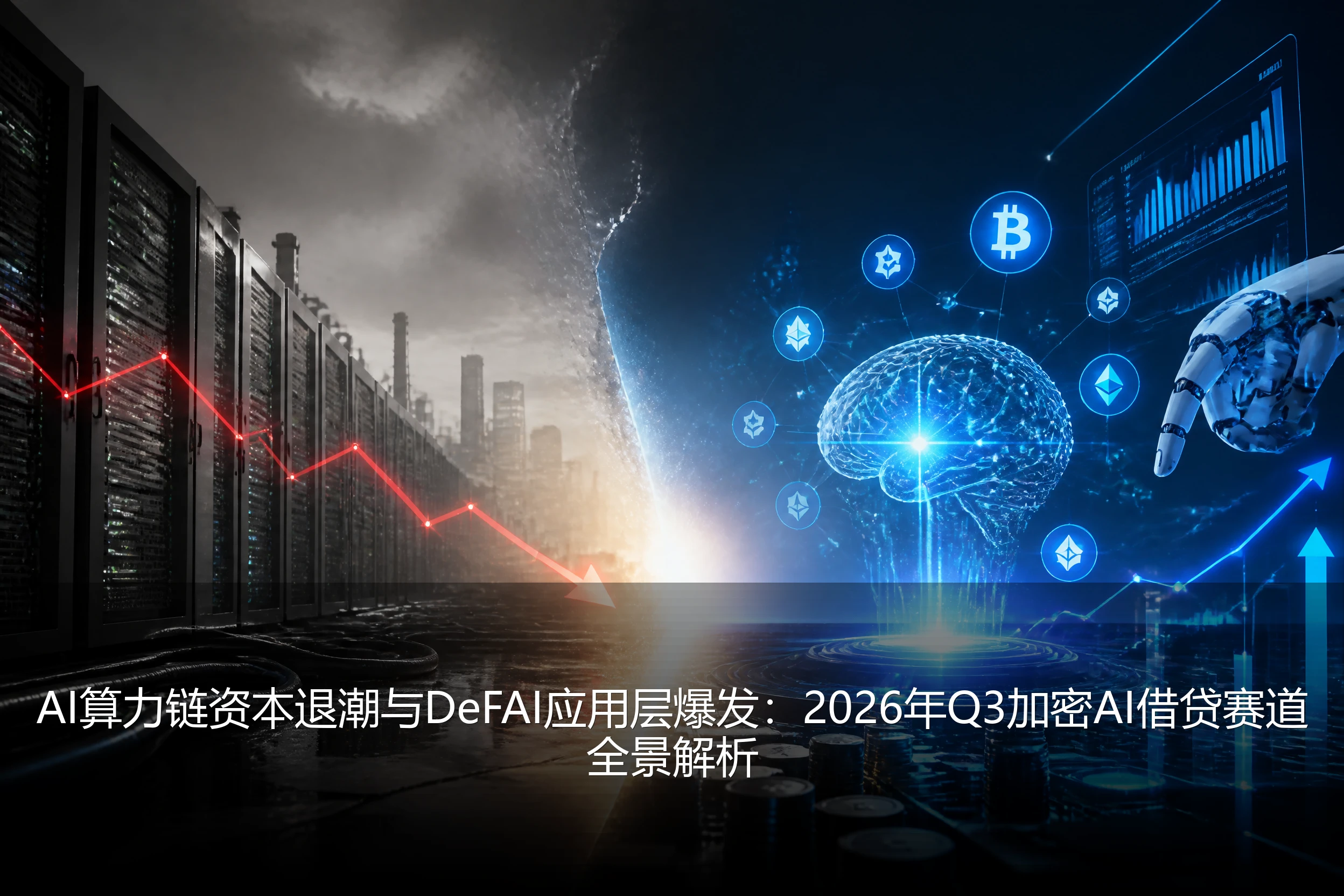
In August 2026, the global artificial intelligence industry is experiencing a profound capital migration. With the disclosure of the latest financial reports of major technology giants, a clear market signal is emerging: the two-year "violent burning of money" stage of AI computing power infrastructure is approaching a top balance point. Traditional AI concept stocks, especially hardware and server rental companies in the upstream of the computing power chain, have experienced severe valuation killings during the mid-year report season. However, while traditional computing power sectors are under pressure, the DeFAI (Decentralized Finance Artificial Intelligence) track, centered on AI-driven encrypted lending and DeFi intelligent risk control, shows a completely opposite capital trend, not only attracting capital against the trend but also showing strong resilience in the capital market turmoil, becoming a new reservoir for institutional funds to cycle through the market.
1. Retreat of the Computing Power Chain: From "Infrastructure Maniac" to "Cash Flow Anxiety"
In the third quarter of 2026, the investment logic of the AI industry is undergoing fundamental reconstruction. In the past two years, the market's core narrative has been focused on "computing power equals power", with capital crazily pouring into GPU cluster construction, data center energy support, and computing power rental markets. However, with the capacity ramp-up of NVIDIA's next-generation Blackwell Ultra chips and the阶段性 completion of ultra-large-scale data center construction, the supply-demand relationship in the computing power market is undergoing subtle changes.
Recent financial report guidance from several computing power rental leaders shows that although the absolute revenue value is still growing, gross margins have shown a month-on-month decline. The reason behind this phenomenon is: on the one hand, the previous high capital expenditures have brought huge depreciation pressure; on the other hand, as the supply side of computing power is released, rental prices have begun to show signs of loosening. The market's reaction to the expectation of "increasing revenue but not profit" is extremely violent. In early August, some traditional AI computing power concept stocks encountered main capital selling after the release of financial reports, showing obvious top signals on the market.
The deeper logic lies in that simply stacking computing power cannot continuously create commercial value. The marginal return of AI large model training is diminishing, while the commercialization of the inference end cannot fill the huge computing power cost in the short term. This "top-heavy" industrial imbalance forces capital to re-examine the value anchor of AI investment. From "technology faith" to "cash flow verification", the market is experiencing a cruel process of eliminating the false and retaining the true.
2. Rise of DeFAI: The Industry Wind Vane of Application Layer Explosion
While the computing power chain is undergoing valuation re-evaluation, the DeFAI track is ushering in historic development opportunities. As the application layer frontier of the AI industry, DeFAI deeply integrates artificial intelligence technology with decentralized finance, reshaping the underlying logic of encrypted lending through AI Agents. In the second half of 2026, DeFAI is becoming the core engine for capital hedging and value appreciation.
The explosion of the DeFAI track is not accidental, but the result of the resonance of technological evolution and market demand. In traditional DeFi lending protocols, over-collateralization is the only means to prevent risks, which leads to extremely low capital utilization. In the DeFAI model, AI-driven intelligent risk control systems can in real-time analyze on-chain data, social graphs, macro market indicators and even off-chain asset certificates, constructing a multi-dimensional on-chain credit scoring system. This leap from "static collateral" to "dynamic credit" greatly releases the liquidity of the encrypted lending market.
Recently, the financial reports of several leading DeFAI protocols have verified the "precise blood generation" capability of this model. Taking the AI-driven encrypted lending leader as an example, its Q2 revenue doubled, not only the number of active borrowing users surged, but the default rate was suppressed to a historical low by the AI risk control model. This tangible profitability is particularly scarce under the current market consensus of "precise blood generation" replacing "violent burning of money".
3. Intelligent Risk Control: The New Investment Mainline in the Post-Computing Power Era
As the AI industry enters the second half, the investment mainline is shifting from "computing power infrastructure" to "intelligent risk control and financial applications". In the post-computing power era, how to use AI technology to improve capital turnover efficiency and reduce systemic risks has become a common issue faced by financial institutions and encrypted protocols.
Intelligent risk control can become the new mainline because of its core hub position in RWA (real-world asset) lending and encrypted native lending. In the RWA market, the on-chain of traditional assets faces pain points such as non-standard asset evaluation and complex default disposal. AI risk control models, by accessing oracle networks and using machine learning algorithms for real-time pricing and risk warning of underlying RWA assets, have broken the trust barrier between traditional finance and DeFi.
In addition, in the encrypted native lending field, AI Agents are playing an increasingly important role. Traditional DeFi protocols rely on manually set parameters to adjust collateral ratios and liquidation thresholds, which can easily trigger chain liquidations in extreme market conditions. The AI Agents in DeFAI protocols can act as autonomous entities, autonomously adjusting risk control parameters based on market volatility, liquidity, and macro sentiment, and even adopting split-order methods during liquidation to reduce slippage losses, thereby protecting the interests of protocols and users.
This technological gap makes DeFAI concept stocks show strong anti-falling ability in the recent market turmoil. Capital is transferring from high-beta computing power stocks to AI risk control concept stocks with stable cash flow expectations. From the market interpretation, institutional fund building positions is obvious, and some DeFAI leading stocks even show an independent upward trend against the market.
4. Prospects and Challenges of the Encrypted AI Lending Track
Although the DeFAI track has broad prospects, as an emerging field, its development still faces many challenges. The first is regulatory compliance. The application boundary of AI in the financial field is still in the exploration stage, especially when AI Agents have asset disposal rights, how to define their legal responsibility has become a focus of regulatory attention. Since 2026, multiple financial regulatory sandboxes have begun to incorporate on-chain credit data into testing, which paves the way for the compliance of DeFAI, but full integration into the mainstream regulatory system still takes time.
The second is technical security challenges. The "black box" problem of AI models itself may lead to unforeseen risks. In extreme market conditions, whether AI risk control models will make collective misjudgments, triggering systemic collapse, is an issue the industry must face. To this end, many DeFAI protocols are beginning to adopt "human-computer collaboration" mechanisms, setting up circuit breakers and manual intervention interfaces on the basis of AI autonomous decision-making to enhance the robustness of risk control.
Finally, data privacy and cost control. High-quality on-chain and off-chain data are the basis for training AI risk control models, but obtaining this data is not only costly but also involves user privacy protection. How to reduce the computing power cost of model training and inference while ensuring data compliance will be the key to future competition in DeFAI protocols.
5. Investment Strategy: Seizing the Layout Window of the DeFAI Track
Facing the current conversion of AI industry trends, investors need to adjust their strategies in a timely manner, shifting from a single computing power faith to in-depth mining of application layer value. In the asset allocation of the second half of 2026, the DeFAI track provides structural opportunities to cycle through bull and bear markets.
First, focus on leading protocols with core risk control technology barriers. In the DeFi field, first-mover advantage is extremely obvious. AI risk control models with rich on-chain data accumulation and iterative experience will form a Matthew effect of the strong getting stronger. Second, focus on subdivided tracks that combine RWA and DeFAI. With the acceleration of the on-chain process of traditional assets, DeFAI protocols that can provide precise pricing and risk control for RWA will receive huge valuation premiums. Finally, for investors in AI concept stocks, they should be alert to the risks of pure concept speculation, return to fundamental analysis, and focus on examining the revenue growth, default control ability, and real user activity of the protocol.
In summary, the third quarter of 2026 is not only a turning point of capital retreat from the AI computing power chain, but also a new starting point for the explosion of the DeFAI application layer. From "violent burning of money" to "precise blood generation", from "computing power infrastructure" to "intelligent risk control", the encrypted AI lending track is reshaping the value chain of the entire fintech industry. In this painful period full of challenges and opportunities, grasping DeFAI as the core engine will be the key for investors to remain invincible in the new cycle.