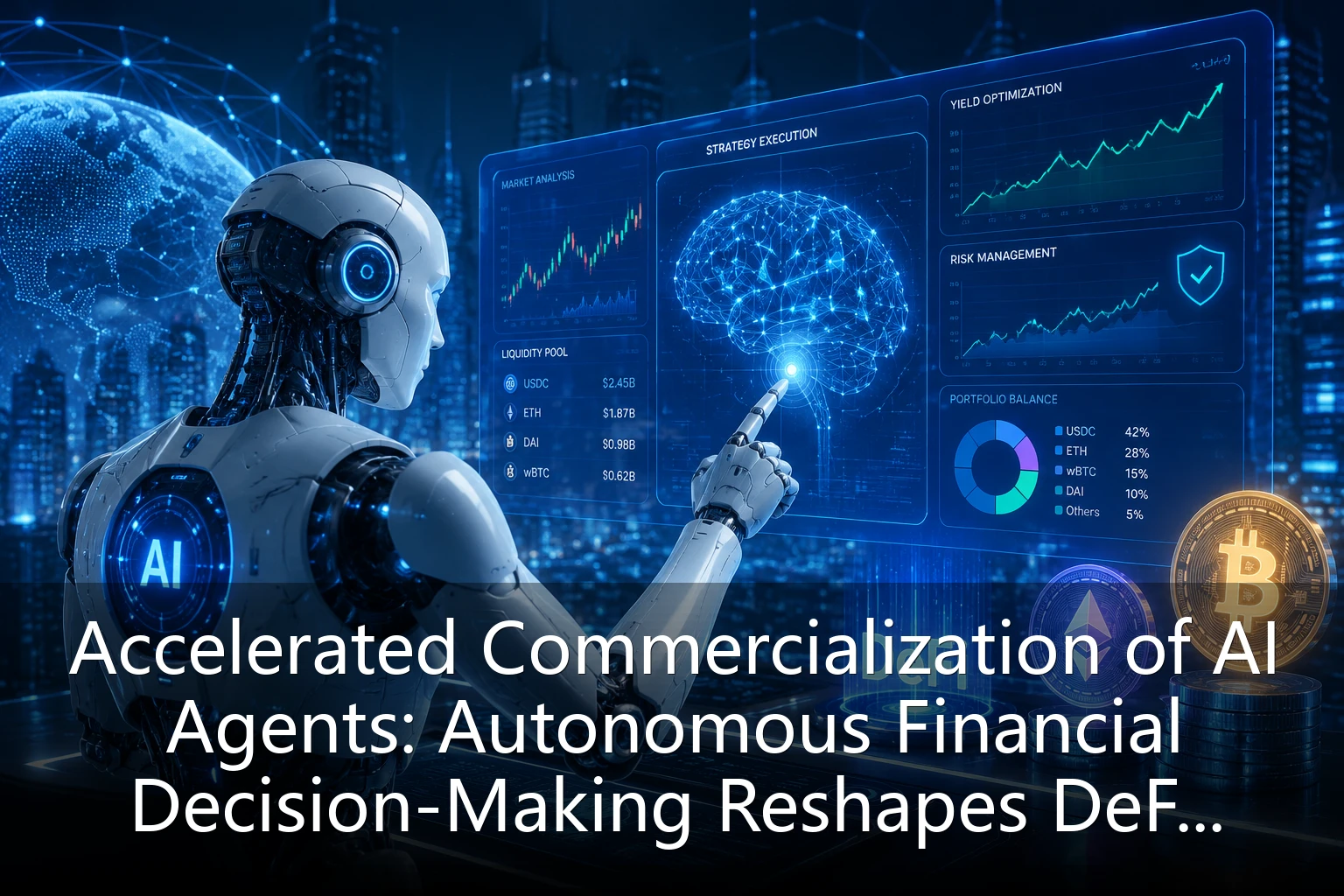
The AI industry narrative for 2026 is quietly shifting gears. If the keywords of the past two years were "Large Models" and "Computing Power," then in the latter half of the year, "AI Agents" are replacing them, becoming the most frequently discussed term in both industry and capital circles. Unlike chatbots specialized in conversation, the core characteristic of an AI Agent is the ability to "autonomously complete tasks": understanding objectives, breaking down steps, calling tools, and executing transactions. This transformation has a particularly profound impact on the financial industry—when AI is no longer just providing suggestions but directly operating accounts, executing payments, and managing assets, the fundamental infrastructure and risk control logic of finance must be re-imagined. Looking at the global financial system, the place best suited to host large-scale AI Agent activities is precisely the on-chain world.
From "Chatting" to "Working": The AI Industry Indicator is Quietly Turning
Over the past two years, the arms race of large models made computing power and data the core assets pursued by capital; however, the industry has gradually realized that merely stacking parameters is not enough to close the business loop; what truly determines the realization of AI value is the "implementation capability." AI Agents are the product of this logic: they upgrade large models from "consultants" to "employees," allowing AI to directly call external tools to complete a series of real actions such as booking, payment, signing contracts, and reconciliation.
From an industry dynamic perspective, since the latter half of 2026, the focus of the AI industry has clearly shifted from the "model layer" to the "application and execution layers." This is reflected in the capital market by a cooling enthusiasm for pure computing power concepts, while the attention to application scenarios that can convert AI capabilities into real cash flow has significantly increased. This trend is consistent with the narrative of "from computing power faith to DeFAI implementation" that this site has continuously tracked, and the explosion of AI Agents is pushing this main thread deeper.
Why the On-Chain World First Embraced AI Agents?
A fascinating phenomenon is that the first large-scale financial scenarios where AI Agents are implemented did not appear in the traditional banking system but first sprouted in the crypto and DeFi ecosystems. There are three main reasons behind this:
* Natural account compatibility. On-chain wallets are inherently designed as account systems for non-human entities. AI Agents hold on-chain addresses, sign transactions, and call smart contracts, virtually eliminating the identity barrier found in traditional finance where the account holder must be a natural person or a legal entity.
* 24/7 settlement network operation. Stablecoins and public chain settlements operate 24/7 without interruption, naturally matching the "tireless" working rhythm of AI Agents; whereas the settlement windows and approval processes of traditional finance are precisely the areas least suited for machine automation.
* Permissions can be programmatically defined. Through technologies like smart contracts and account abstraction, developers can precisely define how much money an AI Agent can move, which protocols it can operate, and when a circuit breaker should be triggered. This fine-grained permission control is something traditional online banking systems struggle to provide.
For this reason, the industry is increasingly tending to view "AI Agent + Stablecoin + DeFi" as the prototype of next-generation financial infrastructure, which is what is called "Agentic Finance."
Machine Credit: The Next Paradigm of On-Chain Lending For the on-chain lending sector, the significance of agents goes beyond merely adding another user type; it lies in the reconstruction of the credit system. In traditional DeFi, borrowing requires over-collateralization, and credit dimensions are relatively singular. The introduction of agents opens up imaginative possibilities for "algorithmic credit"—AI can analyze protocol cash flow, collateral quality, and on-chain behavioral characteristics in real-time to dynamically price lending needs for different risk levels.
Furthermore, with the emergence of novel collateral types such as computing power assets and tokenized revenue rights, the business model of "machines as borrowers" is moving from concept to testing ground: a node running AI inference services can collateralize its future computing power income after tokenization to secure financing, achieving a closed loop of "computing power as credit." This direction is consistent with the "computing power collateralized lending" previously discussed on this site, but the novelty in the agent era is that the lending, borrowing, and rating processes can all be completed collaboratively by AI, forming a truly automated credit machine. For the AI lending and DeFAI concept sections, this constitutes a crucial pillar of the long-term narrative.
Risk control is an unavoidable hurdle.
Of course, while the ideal is grand, there are still many engineering and governance issues to be solved in reality:
* How can losses be stopped in milliseconds after an agent is subjected to prompt attacks or smart contract exploits?
* Could the chained interactions between multiple agents amplify systemic risk?
* How is the liability for "machine-induced losses" divided? Current regulatory frameworks have not provided a clear answer.
The mainstream approach currently is "tiered authorization + multi-signature + circuit breaker mechanism": small, high-frequency operations are delegated to autonomous agents, while large and sensitive operations must be returned for human confirmation, alongside setting daily limits and intercepting abnormal behavior. It can be said that intelligent risk control capabilities are upgrading from a bonus feature of DeFAI projects to a survival necessity—this also explains why institutional capital has recently favored assets with intelligent risk control.
Three insights for the AI industry and capital markets.
Returning to the positioning of an "AI industry barometer," the signal provided by the agent wave is clear:
* First, the valuation anchor of the AI industry is shifting from "parameter scale" to "task completion rate." Whoever can prove that AI can independently complete tasks with economic value will gain market premium.
* Second, finance is one of the fastest sectors for agent monetization, and on-chain finance, with its frictionless and programmable nature, is becoming the cutting-edge testing ground for the integration of AI and finance.
* Third, with the development of agency finance, infrastructure segments such as stablecoin payments, account abstraction, AI risk control, and RWA tokenization are expected to achieve synergistic benefits.
For investors, the risk of narrative overheating must be guarded against: agents are still in the early stages, and safety incidents and regulatory uncertainty could trigger sector volatility at any time. A more prudent approach is to focus on leading projects that possess real protocol revenue, mature risk control frameworks, and clear compliance paths, rather than merely chasing conceptual labels.
From "computing power faith" to "agent execution," the AI industry is undergoing a transition from means of production to relations of production. When machines begin to possess accounts, credit, and payment capabilities, the rules of the financial world will be rewritten. For observers at the intersection of AI and crypto, this may be the most worth-tracking industry trend in the second half of 2026.